Showing posts with label Literary finds. Show all posts
Showing posts with label Literary finds. Show all posts
Saturday, April 5, 2014
SHAKESPEARE AT 450 - CELEBRATE WITH A WEDGWOOD GIFT
April 26th will be the 450th anniversary of the baptism of William Shakespeare in Stratford upon Avon. His exact birthdate is unknown, frequently it is celebrated on April 23rd, St. George's Day, but suffice it to say, this month is his 450th! Why not celebrate with a little Wedgwood tray with his profile in pale blue and white jasper, or a great tankard with a Shakespeare plays theme? You can go here to see what we have in stock.


Monday, October 14, 2013
JOSEPH PRIESTLEY CORRESPONDENCE located in USA - including letter to THOMAS WEDGWOOD

Tuesday, July 16, 2013
TRAITOR BENEDICT ARNOLD, AFICIONADO OF WEDGWOOD - WHO KNEW?
Recently I won a book through Fieldstome Common History Radio, a web-based radio show all about genealogy and American History. The book I won is "Defiant Brides, the Untold Story of Two Revolutionary-era Women and the Radical Men They Married". This is the story of the parallels in time and place of Peggy Shippen Arnold, Mrs. Benedict, and Lucy Flucker Knox, Mrs. Henry. It is a well-written biography of two strong women who found themselves on the main stages of America's history during the American Revolutionary period.
As we Wedgwoodians so often find, one just never knows where a Wedgwood reference will pop up. It happens to many of us frequently and we share our encounters with one another in many ways. This one is another on my long list of Wedgwood-in-totally-unexpected-places finds. On page 136 we learn: "Superficially, the Arnolds' social success in London society in 1782 seemed ensured. Though not fabulously wealthy, the Arnolds lived luxuriously. Their townhouse was outfitted with fine mahogany furniture; their table handsomely appointed with fine silver, crystal, and Wedgwood..." And on page 155 we find Benedict and Peggy back on the North American continent, in St. John, New Brunswick, Canada. "The Arnolds' clapboard home on the corner of King and Cross (now Canterbury) streets was less stately than their London townhouse but, by Saint John standards, still impressive. Two and a half stories high with a gambrel roof, it symbolized Arnold's status as a town father. Within it stood the family's London furnishings, blue-damask sofas, matching curtains, mahogany chairs cabinets and chests, Wedgwood dishes, giltware, and a globe." Who knew someone so vilified in our history could have the good sense and good taste to own Wedgwood china? Perhaps we can't excuse his poor behaviour but we can at least give him a modicum of credit for his good sense in some of life's luxuries.
For an interesting look into the personal lives of two important players on the Revolutionary stage, you might want to check out Nancy Rubin Stuart's book, Defiant Brides, published by Beacon Press, Boston, 2013, www.beacon.org. And a big thank-you to Marian Pierre-Louis and her stellar programming on Fieldstone Common for running the give-away! You can learn a lot of history and genealogy at www.blogtalkradio.com/FieldstoneCommon.

As we Wedgwoodians so often find, one just never knows where a Wedgwood reference will pop up. It happens to many of us frequently and we share our encounters with one another in many ways. This one is another on my long list of Wedgwood-in-totally-unexpected-places finds. On page 136 we learn: "Superficially, the Arnolds' social success in London society in 1782 seemed ensured. Though not fabulously wealthy, the Arnolds lived luxuriously. Their townhouse was outfitted with fine mahogany furniture; their table handsomely appointed with fine silver, crystal, and Wedgwood..." And on page 155 we find Benedict and Peggy back on the North American continent, in St. John, New Brunswick, Canada. "The Arnolds' clapboard home on the corner of King and Cross (now Canterbury) streets was less stately than their London townhouse but, by Saint John standards, still impressive. Two and a half stories high with a gambrel roof, it symbolized Arnold's status as a town father. Within it stood the family's London furnishings, blue-damask sofas, matching curtains, mahogany chairs cabinets and chests, Wedgwood dishes, giltware, and a globe." Who knew someone so vilified in our history could have the good sense and good taste to own Wedgwood china? Perhaps we can't excuse his poor behaviour but we can at least give him a modicum of credit for his good sense in some of life's luxuries.
For an interesting look into the personal lives of two important players on the Revolutionary stage, you might want to check out Nancy Rubin Stuart's book, Defiant Brides, published by Beacon Press, Boston, 2013, www.beacon.org. And a big thank-you to Marian Pierre-Louis and her stellar programming on Fieldstone Common for running the give-away! You can learn a lot of history and genealogy at www.blogtalkradio.com/FieldstoneCommon.

Saturday, December 15, 2012
ANOTHER REVIEW OF THE POTTER'S HAND BY A.N. WILSON
If interested readers will scroll down to my 9/1 post about this book, one will see my initial interest in the book, my subsequent slightly negative reaction to it, and several reviews by other people. The Wedgwood Society of New South Wales publishes a newsletter and with permission of the reviewer and the Editor, I am posting her review in the latest issue of The Medallion, the Society's newsletter. Dianne Parrey points out that those of us who know the factual stories of Josiah, the factory, his associates and the family will likely be more critical of this book. Perhaps someone without that Wedgwood background will enjoy the book because of viewing the story through different eyes. Appreciation to our Australian friends for allowing us to publish this review, and particular thanks to Dianne.
The Potter’s Hand
Reviewed by Dianne Parrey
On the last page of A.N. Wilson’s book “The Potter’s Hand” there is a note on the author explaining how he is a biographer and a novelist of renown having even been “longlisted for the Man Booker Prize”. (Wilson: p. 506) I have to admit that I am truly sorry Wilson did not stick to biography or write a truly original novel because the mix that he has created is quite disturbing. There are some beautiful descriptions in the story that clearly illustrate Wilson’s capabilities as a writer, for example I found “[t]he violent orange of the setting sun caught the frozen puddles in the fields and was reflected with a series of dazzling colour splashes” (Wilson: p.96) a lovely image. Or when Wilson describes Stubbs' journey up the canal noting “the billowing white and charcoal clouds promised rain again as they brooded in the pale blue sky”. (Wilson: p. 297) However, the story is full of so many historical inaccuracies, that for a student of Wedgwood or eighteenth century history the book becomes quite frustrating.
As a love story, a story of unhappiness and ambition, and desire, there is certainly some merit but the book is too melancholy and aims to shock too much such as the death of the guard after Wilson describes how the Russian Empress decides to take sexual advantage of him. (Wilson: p. 163) I also found Wilson’s dislike of his characters Sally and Jos Wedgwood and the children and his, at times, offensive descriptions off putting. Characters they are because they bear little resemblance to the people that can be gleaned from Josiah’s own letters.
If I had written this review based on the first five chapters of the book my comment would have been ‘don’t bother’. However, I have to say that as I read the book and consciously tried to treat the book as simply a work of fiction I did briefly enjoy some chapters but these sections were very few and tended o be the chapters that dealt with the purely created characters such as the scene of Caleb and Meribah at the pond. (Wilson: pp. 458–59)
There is a wealth of reference to the great men of the industrial and political revolutions. However, unfortunately in many cases the facts are wrong. One of the things I find most desirable about historical fiction is the accuracy of the facts—the ability to weave a fiction story in and out of the reality. Wilson fails to do this. I think it is clear by the beginning of Part Two that Wilson should have written a book on the American Revolution, a separate one on Wedgwood and a separate love story for his created characters.
I desperately wanted to know Stubbs and Dr. Darwin better and had hoped that someone whose own personal history had been influenced by the factory (his father having worked for the company) might have been able to bring these characters to life. In the end there were so many inaccuracies that I was glad when I had finished the book. I believe anyone who has a strong attachment to history, especially Wedgwood history, should not read this book or should do so warily because even Wilson admits in his afterword that he played with the facts changing the dates, including the date the Frog Service was finished, to fit in with his storyline. (Wilson: p. 504) He created letters and I believe put inappropriate words into the mouths of people who would never have said some of the things he has them saying. Wilson has also created some very disturbing references to various characters and the descriptions of Mary Ann’s suffering are very confronting (Wilson: p. 426). Some readers will find some of the sexual references, (Wilson: pp. 55 and 163) the shallowness of the characters and the violence in the Cherokee massacre very disturbing (Wilson: p. 167).
I believe it is essential to approach this book in the clear knowledge that this is very much a piece of fiction with some very predictable story lines spiced with incidents meant to shock; at times filtered with some truly disturbing scenes, and yet written by an author who, at times, is almost poetic in his descriptions. For someone who knows nothing about Wedgwood the undesirable impact would be less.
What reading this book has done for me though is to make me want to start rereading the volumes of Wedgwood’s letters in the hope of wiping out the memory of some of the depictions of Wedgwood in Wilson’s book that I found really unpleasant.
The Potter’s Hand
Reviewed by Dianne Parrey
On the last page of A.N. Wilson’s book “The Potter’s Hand” there is a note on the author explaining how he is a biographer and a novelist of renown having even been “longlisted for the Man Booker Prize”. (Wilson: p. 506) I have to admit that I am truly sorry Wilson did not stick to biography or write a truly original novel because the mix that he has created is quite disturbing. There are some beautiful descriptions in the story that clearly illustrate Wilson’s capabilities as a writer, for example I found “[t]he violent orange of the setting sun caught the frozen puddles in the fields and was reflected with a series of dazzling colour splashes” (Wilson: p.96) a lovely image. Or when Wilson describes Stubbs' journey up the canal noting “the billowing white and charcoal clouds promised rain again as they brooded in the pale blue sky”. (Wilson: p. 297) However, the story is full of so many historical inaccuracies, that for a student of Wedgwood or eighteenth century history the book becomes quite frustrating.
As a love story, a story of unhappiness and ambition, and desire, there is certainly some merit but the book is too melancholy and aims to shock too much such as the death of the guard after Wilson describes how the Russian Empress decides to take sexual advantage of him. (Wilson: p. 163) I also found Wilson’s dislike of his characters Sally and Jos Wedgwood and the children and his, at times, offensive descriptions off putting. Characters they are because they bear little resemblance to the people that can be gleaned from Josiah’s own letters.
If I had written this review based on the first five chapters of the book my comment would have been ‘don’t bother’. However, I have to say that as I read the book and consciously tried to treat the book as simply a work of fiction I did briefly enjoy some chapters but these sections were very few and tended o be the chapters that dealt with the purely created characters such as the scene of Caleb and Meribah at the pond. (Wilson: pp. 458–59)
There is a wealth of reference to the great men of the industrial and political revolutions. However, unfortunately in many cases the facts are wrong. One of the things I find most desirable about historical fiction is the accuracy of the facts—the ability to weave a fiction story in and out of the reality. Wilson fails to do this. I think it is clear by the beginning of Part Two that Wilson should have written a book on the American Revolution, a separate one on Wedgwood and a separate love story for his created characters.
I desperately wanted to know Stubbs and Dr. Darwin better and had hoped that someone whose own personal history had been influenced by the factory (his father having worked for the company) might have been able to bring these characters to life. In the end there were so many inaccuracies that I was glad when I had finished the book. I believe anyone who has a strong attachment to history, especially Wedgwood history, should not read this book or should do so warily because even Wilson admits in his afterword that he played with the facts changing the dates, including the date the Frog Service was finished, to fit in with his storyline. (Wilson: p. 504) He created letters and I believe put inappropriate words into the mouths of people who would never have said some of the things he has them saying. Wilson has also created some very disturbing references to various characters and the descriptions of Mary Ann’s suffering are very confronting (Wilson: p. 426). Some readers will find some of the sexual references, (Wilson: pp. 55 and 163) the shallowness of the characters and the violence in the Cherokee massacre very disturbing (Wilson: p. 167).
I believe it is essential to approach this book in the clear knowledge that this is very much a piece of fiction with some very predictable story lines spiced with incidents meant to shock; at times filtered with some truly disturbing scenes, and yet written by an author who, at times, is almost poetic in his descriptions. For someone who knows nothing about Wedgwood the undesirable impact would be less.
What reading this book has done for me though is to make me want to start rereading the volumes of Wedgwood’s letters in the hope of wiping out the memory of some of the depictions of Wedgwood in Wilson’s book that I found really unpleasant.
Thursday, November 15, 2012
London Evening News Features Portland Vase restored with Wedgwood's help


Saturday, September 1, 2012
NEW A N Wilson WEDGWOOD NOVEL PUBLISHED TODAY - GREAT BOOK REVIEW
Back in February I posted a preview of an interesting sounding new book by the son of the late famed Wedgwood designer Norman. Wilson, The Potter's Hand by A. N. Wilson. It was promised to be published by Atlantic Books today, and so it was. Tristram Hunt, British MP, and one of my favorite living Brits, has written an excellent, detailed review of the book which appears in today's Financial Times. I am pleased to post it here for the viewing of all Wedgwoodians. It's a fictional work laced with a dose of reality. Click here to go directly to Hunt's excellent review, it'll probably make you want to order this book today, I've ordered mine from Amazon.com, less than $25us including shipping from UK. [My book arrived today, 9/8, GREAT service from the Amazon seller "The Book Depository" in UK. Shipping was only $3.99. I can't wait to begin reading!] HERE is another great review I just found from Country Life Bookshop in UK. "This is the historical novel at its most ambitious." And HERE is yet another review with interesting photos which I think our readers will enjoy ~ Wilson's own commentary on his novel is insightful as one begins to read the book.
 November 7 - I've begun reading the book and am also hearing from my Wedgwood friends around the world....the reviews of the book are less than stellar, and I'm having trouble giving the book much of my time. I find it laborious to read and perhaps too much on the negative side to enjoy it. Personally I am lover of historical fiction, and read quite a bit of it; however in this case, since so much is actually known about the Wedgwoods from letters, journals and other sources, this fictional story isn't seeming even plausible, let alone entertaining. For me, to deserve my time, a book must offer me something, even if it is a fictional story to provide a bit of escape from reality. Admittedly it's not finished yet, and admittedly I am biased in favor of the Wedgwoods, but I'm thinking I might not allow The Potter's Hand much more of my time - perhaps unfair but it IS my time to value isn't it? My friends' reviews are definitely coloring my opinion, so fairness would dictate my finishing the book...I'll let you know my decision! I'd be interested in having readers comment here on how they view this book. November 9th, I've found another review from the UK Telegraph which gives a bit of insight into the book, go HERE to read it and see a photo of the author.

Monday, July 4, 2011
Hensleigh Wedgwood chimes in on that Pesky Extra E
While researching in my library sometime back, I randomly picked a book from the shelf and to my delight noticed it had been one of Elizabeth Chellis'. The title page of Staffordshire Pottery and its History by Josiah C. Wedgwood does not state a publication date, but in Elizabeth's hand in pencil I found: [1913]? 1922 says C V Wedgwood check again I smiled as I thought about her thorough attention to detail. I found enclosed in the front a news-clipping from the local Wellesley newspaper of 12 Feb 1953- an ad for the local Community Playhouse with coming attractions, a fun commentary on the times, to wit: The Promoter, Operation Secret (with Karl Malden), Everything I Have is Yours, with Marge and Gower Champion and Claudette Colbert in Outpost in Malaya. More interesting to us Wedgwoodians perhaps is an article, dated 4 Feb 1947, from the Boston Herald which I think bears repeating: "Hensley [sic] Wedgwood, of the British family whose name is famed in china and pottery, arrived in this country recently on a business trip. He was interviewed by a group of newspaper and magazine writers about the manufacture and sale of Wedgwood...One interviewer noticed that in his lapel [he] wore a tiny pin on which was the letter 'E'. Wedgwood was asked whether this was a British award similar to the 'E' Awards, given by the War and Navy Depts. during the war. 'Not at all,' said Wedgwood. 'It's there to remind people abut the correct spelling of my name-that there's only one 'E' in Wedgwood'". One would think that since the article was about the spelling of his name, the newspaper proofers would be sure his FIRST name was spelled correctly! Perhaps we need to retell this story to young collectors, those on eBay and other places where we SO often find this annoying mis-spelling. We really need to commission a jewelry manufacturer to make us a blue & white enamel E lapel pin! In a quick search for a photo of Hensleigh, I found a very interesting article by Hensleigh in a 1970 issue of American Heritage about Josiah, another article about our favorite potter, which bears a good read. Click the title of this post to read it! And another amazing find popped up as I searched for that picture of Hensleigh. Check out this book by a much earlier Hensleigh Wedgwood! I don't remember having heard of this one, but perhaps I have and simply never investigated!
And from the back of Elizabeth's book, perhaps used as a placemarker, fell a short poem cut from a newspaper without attribution or date with which I close, in hopes that someday when my library is disseminated others will enjoy the odds and ends I seem to be constantly tucking inside my books.
STAFFORD CANAL
Where lichened locks all dripping cool
So deeply store their limpid pool,
Gay-painted barges dream and drowse
In soft shadows of haymows.
And by the inn with open door
Old bargemen speak of water lore,
Crews or cargoes, miles per day,
Copper bars, and bales of hay.
[wonder if Elizabeth itched to change this to 'pots of clay' as do I]
While off in distant growing gloom
I see dark massive Wrekin loom,
Low lightning-lit in Shropshire sky.
An anchored cloud as night flows by.
R. N. T.

And from the back of Elizabeth's book, perhaps used as a placemarker, fell a short poem cut from a newspaper without attribution or date with which I close, in hopes that someday when my library is disseminated others will enjoy the odds and ends I seem to be constantly tucking inside my books.
STAFFORD CANAL
Where lichened locks all dripping cool
So deeply store their limpid pool,
Gay-painted barges dream and drowse
In soft shadows of haymows.
And by the inn with open door
Old bargemen speak of water lore,
Crews or cargoes, miles per day,
Copper bars, and bales of hay.
[wonder if Elizabeth itched to change this to 'pots of clay' as do I]
While off in distant growing gloom
I see dark massive Wrekin loom,
Low lightning-lit in Shropshire sky.
An anchored cloud as night flows by.
R. N. T.
Thursday, February 17, 2011
GREAT WEDGWOOD & DARWIN INTEREST WEBSITE TO EXPLORE

Charles Darwin image from American Heritage Archives
With all the recent publicity on all things Darwin, I somehow missed a real treat. Click the title of this post to discover a great website, by and about the beautiful Emma Darwin, a young mother, successful author, and great great grand-daughter of Charles & Emma Wedgwood Darwin. She is a beautiful girl, and her story and stories are worth investigating. Her two historical novels sound thrilling, I think I'll check them both out. It's a very well done website cum blog so I think a lot of us Wedgwoodians will enjoy it! The caption that goes with this photo found at American Heritage Archives reads: "'He is the most transparent man I ever saw,' said Emma Wedgwood of the cousin she was to marry. Water colors painted in 1840 by the popular portraitist George Richmond show how alike Emma and Charles were in looks. Their similarity in temperament made their marriage a most happy one." Credit: Courtesy of George P. Darwin and the Royal College of Surgeons.
Thursday, February 10, 2011
WEDGWOOD PEDIGREES A BOOK REVIEW
Here follows a book review from a crumbling, yellowed newspaper article from ‘The Staffordshire Sentinel’ dated March 30, 1926 [the book was published in 1925] which was found by me in an old Wedgwood-related book. The typeface is very small, requiring some reading, especially in the fold-lines, by magnifier! I always love it when my passions for Wedgwood and genealogy collide!
“Wedgwood Pedigrees. Being an account of the complete family reconstructed from contemporary records. By the Right Hon. Josiah C. Wedgwood and Joshua G. E. Wedgwood, is published by Titus Wilson, 21s. net. The “Times” Literary Supplement gives the following delightful review of the book:
No man is entirely individual. He is the product of his line through past ages. Much of his character is born of incident in some past century to some perhaps forgotten forebear. Environment may modify or develop, but it does not replace in one or two generations the characteristics of ancestry, and much in the behaviour of the living may be explained by a history of the dead. Thus genealogy has a special importance quite apart from the natural pride in illustrious descent. And undertaken in the proper spirit the construction of a family pedigree may be accounted a virtue and a public service. In the United States much progress has been made in scientific genealogical research; and apart from those who endeavour to link themselves with the great ones of the past there are many who have spent much time and money in the preparation of pedigrees both honest and accurate. England has lagged behind in recent years but in this volume of Wedgwood pedigrees there is proof that some at least have both the skill and the patience to undertake such work.
The authors’ task has been simplified by the relative rarity of the name. There is only one Wedgwood in England, and it is a fairly safe presumption that all bearing the name of Wedgwood came from the farm of Wedgwood, near Tunstall. Thus the search was narrowed in its earliest stages to an examination of all records which dealt with Wedgwood and the surrounding area of country. The farm was one of the frank-pledges of the Manor of Tunstall held after the Conquest by the Audleys. The first Wedgwood known to history was, as the authors note with some glee, a rebel, one Richard, who was given a safe conduct to come to the King’s Court in June 1266. But his fate is covered by the mists of the past.
When first the authors began their researches into the family history they relied in the main on the Tunstall Court records, and with some aid from other documents constructed a skeleton pedigree of Wedgwoods from 1299 to 1589. The references to the family were not many, and all were short. Much had to be presumed, and there was no definite proof that the persons in the pedigree had been linked correctly until at a recent date the Horton Court Rolls were discovered and gave evidence that the deductions had been correct. At first it was a family of small but respectable farmers-despite one or two murderers, who appear to break the monotony. As the years passed so did the circumstances of one branch, that of Heracles, improve, until in the sixteenth century it rose to the squirearchy, coat armour, and a place in the county. Marriages helped, but some credit must be given to the character of the race. The Heracles branch ended in the male line in 1757, and their wealth left the family.
But by this time another branch of the family was well on the road to fame. In the seventeenth century Wedgwoods had settled in Burslem, and about 1650 Thomas of that name began operations as a potter. Josiah Wedgwood, whose name is now a household word, was a descendant of this Thomas, and in 1767 he settled at Etruria, where he built the still famous works. He was a man of strong opinions, a Radical Dissenter, and a believer in Parliamentary reform. His character survives, according to the authors, in the family today. They say:-
“Wedgwoods do not mix. They are not happy talking to outsiders-not superior, but shy with the shyness of men who have a complete world of their own...Seven generations brought up upon Miss Austen and Macaulay cannot acclimatize themselves to the sort of people who know whether pheasants do or do not eat mangle wurzels and are aware that the Grand National is not a flat race. They never made a bet in their lives, not because they would not have done so with pleasure if it would have broken down the barrier between themselves and mankind, but because they did not know how the operation was performed. If a Wedgwood or a Darwin ever got drunk, it must have been in the pursuit either of scientific knowledge or of an illusive camaraderie with those who really liked that sort of thing.”
A pleasant picture is given of the relations between masters and men of the Wedgwood’s high conception of an employer’s responsibility. “Paternal” care was carried, one might think, a little far on occasion. “After the midday meal was over, or in the evenings, my father read aloud to the ‘hands’-read Macaulay and Mill. ‘Hands’ that will stand that will stand most things.” But that affection of high order exists between the Wedgwoods and their employees is obvious.
One Wedgwood of this line died a Guards Colonel, and, as an ensign in the Scots Fusilier Guards, was with his company in Hougomont throughout the day at Waterloo. Another Wedgwood (Josiah 1768-1843) paid an annuity to Samuel Taylor Coleridge. A branch of the family emigrated to America in 1630 and descendants still exist, as the long lists given in the book prove. Other branches settled in Warwickshire, Cumberland and Yorkshire. All these are included in the authors’ task. Their work has been well done. Few family genealogies have been constructed with such care rendered to history. There are 120 pages of indices containing sufficient material to permit of the reader testing for himself the accuracy of the authors’ deductions."
We love sharing Wedgwood family information knowing there are MANY Wedgwood descendants around the globe. Hopefully in our musings sometimes we might find a snippet that not all the family members know. Watch for another article soon from a member of the "American branch" of the Wedgwood family. And be sure to browse our book category on the website, we have some Wedgwood family history books for sale. Click the title of this post to see a spectacular old leatherbound volume of one family history, and from there you can click the category name to see all our books.
“Wedgwood Pedigrees. Being an account of the complete family reconstructed from contemporary records. By the Right Hon. Josiah C. Wedgwood and Joshua G. E. Wedgwood, is published by Titus Wilson, 21s. net. The “Times” Literary Supplement gives the following delightful review of the book:
No man is entirely individual. He is the product of his line through past ages. Much of his character is born of incident in some past century to some perhaps forgotten forebear. Environment may modify or develop, but it does not replace in one or two generations the characteristics of ancestry, and much in the behaviour of the living may be explained by a history of the dead. Thus genealogy has a special importance quite apart from the natural pride in illustrious descent. And undertaken in the proper spirit the construction of a family pedigree may be accounted a virtue and a public service. In the United States much progress has been made in scientific genealogical research; and apart from those who endeavour to link themselves with the great ones of the past there are many who have spent much time and money in the preparation of pedigrees both honest and accurate. England has lagged behind in recent years but in this volume of Wedgwood pedigrees there is proof that some at least have both the skill and the patience to undertake such work.
The authors’ task has been simplified by the relative rarity of the name. There is only one Wedgwood in England, and it is a fairly safe presumption that all bearing the name of Wedgwood came from the farm of Wedgwood, near Tunstall. Thus the search was narrowed in its earliest stages to an examination of all records which dealt with Wedgwood and the surrounding area of country. The farm was one of the frank-pledges of the Manor of Tunstall held after the Conquest by the Audleys. The first Wedgwood known to history was, as the authors note with some glee, a rebel, one Richard, who was given a safe conduct to come to the King’s Court in June 1266. But his fate is covered by the mists of the past.
When first the authors began their researches into the family history they relied in the main on the Tunstall Court records, and with some aid from other documents constructed a skeleton pedigree of Wedgwoods from 1299 to 1589. The references to the family were not many, and all were short. Much had to be presumed, and there was no definite proof that the persons in the pedigree had been linked correctly until at a recent date the Horton Court Rolls were discovered and gave evidence that the deductions had been correct. At first it was a family of small but respectable farmers-despite one or two murderers, who appear to break the monotony. As the years passed so did the circumstances of one branch, that of Heracles, improve, until in the sixteenth century it rose to the squirearchy, coat armour, and a place in the county. Marriages helped, but some credit must be given to the character of the race. The Heracles branch ended in the male line in 1757, and their wealth left the family.
But by this time another branch of the family was well on the road to fame. In the seventeenth century Wedgwoods had settled in Burslem, and about 1650 Thomas of that name began operations as a potter. Josiah Wedgwood, whose name is now a household word, was a descendant of this Thomas, and in 1767 he settled at Etruria, where he built the still famous works. He was a man of strong opinions, a Radical Dissenter, and a believer in Parliamentary reform. His character survives, according to the authors, in the family today. They say:-
“Wedgwoods do not mix. They are not happy talking to outsiders-not superior, but shy with the shyness of men who have a complete world of their own...Seven generations brought up upon Miss Austen and Macaulay cannot acclimatize themselves to the sort of people who know whether pheasants do or do not eat mangle wurzels and are aware that the Grand National is not a flat race. They never made a bet in their lives, not because they would not have done so with pleasure if it would have broken down the barrier between themselves and mankind, but because they did not know how the operation was performed. If a Wedgwood or a Darwin ever got drunk, it must have been in the pursuit either of scientific knowledge or of an illusive camaraderie with those who really liked that sort of thing.”
A pleasant picture is given of the relations between masters and men of the Wedgwood’s high conception of an employer’s responsibility. “Paternal” care was carried, one might think, a little far on occasion. “After the midday meal was over, or in the evenings, my father read aloud to the ‘hands’-read Macaulay and Mill. ‘Hands’ that will stand that will stand most things.” But that affection of high order exists between the Wedgwoods and their employees is obvious.
One Wedgwood of this line died a Guards Colonel, and, as an ensign in the Scots Fusilier Guards, was with his company in Hougomont throughout the day at Waterloo. Another Wedgwood (Josiah 1768-1843) paid an annuity to Samuel Taylor Coleridge. A branch of the family emigrated to America in 1630 and descendants still exist, as the long lists given in the book prove. Other branches settled in Warwickshire, Cumberland and Yorkshire. All these are included in the authors’ task. Their work has been well done. Few family genealogies have been constructed with such care rendered to history. There are 120 pages of indices containing sufficient material to permit of the reader testing for himself the accuracy of the authors’ deductions."
We love sharing Wedgwood family information knowing there are MANY Wedgwood descendants around the globe. Hopefully in our musings sometimes we might find a snippet that not all the family members know. Watch for another article soon from a member of the "American branch" of the Wedgwood family. And be sure to browse our book category on the website, we have some Wedgwood family history books for sale. Click the title of this post to see a spectacular old leatherbound volume of one family history, and from there you can click the category name to see all our books.
Tuesday, February 1, 2011
A WEDGWOOD VALENTINE
A Wedgwood Valentine from Alexis Antiques
(Click the title of this post to go to some heart shaped inventory which might work as a gift for YOUR Valentine!)
Eldred Hubbard lived from 1856 until his death, with his wife, on the Lusitania in 1915. If you do not know anything about this prolific writer, entrepreneur, publisher, editor and philosopher, or his Roycrofter Corporation, you might want to Google his name or go to www.roycrofter.com for some background information.
Among the vast output of this company’s volumes were 182 booklets called “Little Journeys to the Homes of the Great” written over a period of 14 years. Inspirational stories of successful people, they include such categories as philosophers, scientists and artists. They were later issued in a set of Memorial Editions, hardbound books encompassing all individual “Little Journey” booklets in a given category. In a 1924 ad in another publication, “The Mentor”, we find that the Memorial Editions, originally published in 1916, were being sold as a set, and in fact I have recently seen a full set for sale here in St. Louis. The hardbound compilations were a memorial to Hubbard “…to bring together in one beautiful set those unforgettable gems, recognized as Hubbard’s masterpieces, that take us among the men and women of shining achievement in many fields.”
And what has this to do with Valentines? One of the “Little Journeys to Homes of Great Lovers” is a factual but naïve in style overview of the great love between Josiah & Sarah Wedgwood. The memorial edition combines 12 love stories published in 1906. Among them another that might interest Wedgwoodians is that of Lord Nelson and Lady Hamilton. Tender stories in a simple and forthright, if a bit flowery, style give us insight into the romantic side of these famous people. The 1906 “Little Journeys” are paperback pamphlets, simple brown paper but most pages embellished with stylistic arts & crafts designs. We are also in possession of another copy of the single “Little Journeys” printed on a gray cardstock and very similar, minus some ads in the brown one, but there is no date or other publication or “reprint” information. The memorial edition (hardbound book) has tipped in a print of a line drawing of Josiah – interesting that this is their love story and Sally’s image is absent! To quote Mr. Hubbard regarding Josiah & Sally, in his introduction to the Volume VIII Great Lovers, “Here is a love so great that in its beneficent results we are all yet partakers.” (1916 and still true today!)
Our Valentine to you from Josiah (written to his friend Lord Gower after Josiah & Sarah had been married for 22 years):
I never had a great plan that I did not submit to my wife. She knew all the details of the business, and it was her love for the beautiful that first prompted and inspired me to take up Grecian and Roman Art, and in degree, reproduce the Classic for the world. I worked for her approval, and without her high faith in me I realize that my physical misfortunes would have overcome my will, and failure would have been written large where England has carved the word Success.


Above is the leatherbound cover of the Memorial Edition of 1916 containing all 12 of the "Great Lovers" essays.
(Click the title of this post to go to some heart shaped inventory which might work as a gift for YOUR Valentine!)
Eldred Hubbard lived from 1856 until his death, with his wife, on the Lusitania in 1915. If you do not know anything about this prolific writer, entrepreneur, publisher, editor and philosopher, or his Roycrofter Corporation, you might want to Google his name or go to www.roycrofter.com for some background information.
Among the vast output of this company’s volumes were 182 booklets called “Little Journeys to the Homes of the Great” written over a period of 14 years. Inspirational stories of successful people, they include such categories as philosophers, scientists and artists. They were later issued in a set of Memorial Editions, hardbound books encompassing all individual “Little Journey” booklets in a given category. In a 1924 ad in another publication, “The Mentor”, we find that the Memorial Editions, originally published in 1916, were being sold as a set, and in fact I have recently seen a full set for sale here in St. Louis. The hardbound compilations were a memorial to Hubbard “…to bring together in one beautiful set those unforgettable gems, recognized as Hubbard’s masterpieces, that take us among the men and women of shining achievement in many fields.”
And what has this to do with Valentines? One of the “Little Journeys to Homes of Great Lovers” is a factual but naïve in style overview of the great love between Josiah & Sarah Wedgwood. The memorial edition combines 12 love stories published in 1906. Among them another that might interest Wedgwoodians is that of Lord Nelson and Lady Hamilton. Tender stories in a simple and forthright, if a bit flowery, style give us insight into the romantic side of these famous people. The 1906 “Little Journeys” are paperback pamphlets, simple brown paper but most pages embellished with stylistic arts & crafts designs. We are also in possession of another copy of the single “Little Journeys” printed on a gray cardstock and very similar, minus some ads in the brown one, but there is no date or other publication or “reprint” information. The memorial edition (hardbound book) has tipped in a print of a line drawing of Josiah – interesting that this is their love story and Sally’s image is absent! To quote Mr. Hubbard regarding Josiah & Sally, in his introduction to the Volume VIII Great Lovers, “Here is a love so great that in its beneficent results we are all yet partakers.” (1916 and still true today!)
Our Valentine to you from Josiah (written to his friend Lord Gower after Josiah & Sarah had been married for 22 years):
I never had a great plan that I did not submit to my wife. She knew all the details of the business, and it was her love for the beautiful that first prompted and inspired me to take up Grecian and Roman Art, and in degree, reproduce the Classic for the world. I worked for her approval, and without her high faith in me I realize that my physical misfortunes would have overcome my will, and failure would have been written large where England has carved the word Success.
Above is the leatherbound cover of the Memorial Edition of 1916 containing all 12 of the "Great Lovers" essays.
Thursday, January 20, 2011
WEDGWOOD AND WORLD WAR II

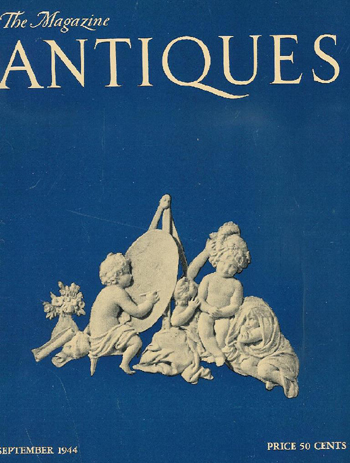
Some of you know I am a magazine addict, especially magazines with Wedgwood articles, ads and photos. I have collected a few issues of The Magazine Antiques from the World War II era which contain Wedgwood articles or references. One day it occured to me that the world was a black place in the months in which these issues, all sporting gorgeous covers, were published. It also occured to me to wonder how the world, those not directly fighting in or running the war, could go so blythely about their business, studying Wedgwood pots for heaven's sake, during such a time! I'd considered the question before, but the reality of the magazine covers struck some sort of chord that I couldn't ignore. One particular article, 'Sources of Wedgwood's Child Motifs', in the September, 1944 issue was written by the late Elizabeth Chellis who was an important contributor to Wedgwood scholarship for many years; her library is now held in the Birmingham (AL) Museum of Art, a vast and valuable resource for collectors, and her legacy to scholars for generations to come. I began to write a review of the article for the newsletter of the Wedgwood Society of Boston, in which Elizabeth and her family were and are active members, but couldn't get past the War; couldn't seem to get interested in reviewing the content of the article. I realized the title itself would tell collectors what the article contained, thus my musings became my article, trying to make sense of the context of the magazine in the world around my parents and grandparents, and all those others who were indelibly affected by the situation of the home front in September of 1944. The review was written nearly five years ago and in the interim I have begun transcribing my paternal grandfather's life-long diaries. I've been working on the World War II years for ages, I keep finding information, photos, cards, internet sites and other things to illustrate grandpa's world. In going through a magazine box recently I rediscovered these 1940s Antiques magazines, and now they are more relevant to me than ever. I am indeed transcribing the detailed minutiae of my grandparents' lives, set against the backdrop of The War. And the same musings keep falling into my brain! How could grandpa record the fact of my uncle's being with Bradley in France in 1945 in the same paragraph as saying that the refrigerator repairman failed to appear as appointed? Lives had to go on, life had to go on, war production and support efforts certainly occupied many minds and hands, but then there were the rest of the hours of the day and night. The Magazine Antiques certainly continued to forge ahead, announcing all the regular antiques shows, running the regular dealers' ads, and presenting great articles on varying subjects of interest to antiques aficionados. I am going to use some of the covers to illustrate the diary entries, perhaps others will let musings along these lines pop into their brains too! Here is the article I wrote, and I highly recommend if you are interested, try collecting some of these back issues from the 1940s! The covers are gorgeous and the early take on the antiques world is interesting too!
Thursday, October 21, 2010
CHEROKEE CLAY
Not being an expert on this subject, I cannot say this article is 100% accurate, but from what I do know it appears to be a nice short introduction to the subject of clay used by Josiah which was dug in North Carolina and shipped to him in Stoke-on-Trent, a long way to go to obtain clay! There is one mis-spelling, and no excuse for it since it's a Wedgwood article! And the author needs to learn how to punctuate properly, as most of his references to articles and books are incorrectly stated, however, as said, it's a nice article of local interest and I didn't spot any glaring errors. Enjoy!
Monday, July 5, 2010
Little Journeys to the homes of GREAT LOVERS
What a pleasant find I've had this morning. At www.readprint.com one can find many books, poems, and short stories to read and print out if desired - all legal. The site encourages sharing of its content and link. The story of the love between Sarah and Josiah Wedgwood is indeed a great one. Her meeting Josiah as a child and seeing his smallpox-marked face and lame leg was the beginning of her life-long love for him and his for her. Elbert Hubbard does a great job of telling the story, with an intro that tells of Thomas Carlyle. I love this quote from Hubbard:
"Love demands opposition and obstacle. It is the intermittent or obstructed current that gives power." Click the title of this post to read Vol. 13 of Hubbard's book. I own two different editions of this book and it makes me smile just to see it on the shelf, let alone read it. If you don't know much about Josiah and Sarah, this is a great introduction to the story of their lives together and influences upon one another, more of which can be found in many of the books about the family. Scroll up to the black & white picture of Josiah on the right and click on it to go to a great book about the family that we have for sale. Happy Reading!
"Love demands opposition and obstacle. It is the intermittent or obstructed current that gives power." Click the title of this post to read Vol. 13 of Hubbard's book. I own two different editions of this book and it makes me smile just to see it on the shelf, let alone read it. If you don't know much about Josiah and Sarah, this is a great introduction to the story of their lives together and influences upon one another, more of which can be found in many of the books about the family. Scroll up to the black & white picture of Josiah on the right and click on it to go to a great book about the family that we have for sale. Happy Reading!
Tuesday, February 2, 2010
THOUGHT PROVOKING EDITORIAL
I'm often asked to appraise items of Wedgwood and other ceramics, frequently dinnerware, and the subject of getting rid of our accumulations of "stuff" comes up. Yesterday I was giving a talk to a group of ladies on a very narrow historical china subject and the dinnerware styles and values subject emerged during the question and answer period. I find myself telling the story of a set of "Edme" dinnerware, about as masculine and classic a pattern as one can imagine. I gave my son a set when he moved into his first apartment after college, of course arriving there dinnerware-less. A few weeks later I was at the apartment seeking a plate, and lo and behold I spotted a set of unfamiliar plain white dishes in the cabinet! When I asked he said, "Oh yeah, I got those at Target, the Wedgwood is in the hall closet boxed up for you to take home." This story illustrates the situation quite a few [million I suspect] of us are facing, our kids don't want the fine things we've collected when we are ready to divest ourselves of them. In my case, my 30somethings won't take their OWN "stuff" let alone the silver, crystal and china I want them to take! This month's Editor's Letter in The Magazine Antiques is a thought-provoking treatise on this exact subject. Elizabeth Pochoda observes that our fretting about the dearth of young collectors may not be so dangerous as we fear. She feels their time to collect will arrive when they are ready. But she brings up another point, that being the possibility that the "culture of collecting" could die out. Her comment that "The digital world has eroded our physical environment" really set me to thinking. Certainly iPods, Kindles and other new gadgets are replacing books; dishwasher safe dishes replacing dinnerware which may require more care and be "fancier" in style and shape is another danger, not part of the digital world, but certainly a casualty of modern technology. She also reminds us that at the magazine they must "worry about how we can widen the circle of people who are passionalte about Shaker boxes and Wedgwood creamware."
Ms. Pochoda suggests to us that giving young people antiques, especially family heirlooms, to help them connect their past to their present and future is a logical step we older collectors can take to encourage the collecting habit. Further she says, "And while there is no digital replacement for a great piece of scrimshaw [Wedgwood] , the habit of accumulating objects may not come naturally to the next generation." This is a valid observation and one upon which I expound often in my business life. Her quotation from Ezra Pound, Canto 81, rings very true:
"What thou lovest well remains, the rest is dross
What thou lov'st well shall not be reft from thee
What thou lov'st well is thy true heritage...."
I've been pondering this subject for quite awhile, and this particular letter ever since my December issue of TMA arrived. However something is absent from her missive, and nearly slipped my own mind. How many of us have chosen to collect something, or many things, not because of the thing, but because of the urge to collect? I'm thinking this is a genetic anamoly, it's in the genes. There are people who just want/need to collect, and if they're lucky, something wonderful emerges from an image, a texture, a scent, a shape, an experience, even a memory perhaps and strikes their fancy inciting them to accumulate that particular thing. Think about the people in your family - I'll bet you'll find another collector hanging around in your family tree....
Me? Oh yes, my kids collect nothing, my mother nothing but recipes because she loved to eat, but that was all. My father? Coins and stamps from his childhood until he died at age 75. My grandmother? Dishes, little boxes, ancestors and matching hats & purses. So, perhaps some of our worry about the lack of young people wanting our china and other "treasures" will turn out to be unfounded, once they have finished their educations, amassed some capital, established their lives, and realized the itch to collect is there...trains, post cards, antique chairs, Wedgwood, they'll all find a way to satisfy that itch! Maybe my girl friends are right, I just have to wait a bit... only worry is that I was already collecting, bottle caps & the color photos on the cover of our newspaper TV listing booklet, by the 3rd grade. Then post cards by 4th, Avon bottles by 7th or so and I had fallen in love with my first Wedgwood (blue jasper of course) by the 8th. Okay, back to my original premise, collecting is in my blood, but probably not my kids'... I often say I wish I had borne more children, not because the two I have aren't wonderful, but for the variety! I wish you all at least one child with the collecting gene! Perhaps if we each give away something old and meaningful this week we'll start a trend!
Ms. Pochoda suggests to us that giving young people antiques, especially family heirlooms, to help them connect their past to their present and future is a logical step we older collectors can take to encourage the collecting habit. Further she says, "And while there is no digital replacement for a great piece of scrimshaw [Wedgwood] , the habit of accumulating objects may not come naturally to the next generation." This is a valid observation and one upon which I expound often in my business life. Her quotation from Ezra Pound, Canto 81, rings very true:
"What thou lovest well remains, the rest is dross
What thou lov'st well shall not be reft from thee
What thou lov'st well is thy true heritage...."
I've been pondering this subject for quite awhile, and this particular letter ever since my December issue of TMA arrived. However something is absent from her missive, and nearly slipped my own mind. How many of us have chosen to collect something, or many things, not because of the thing, but because of the urge to collect? I'm thinking this is a genetic anamoly, it's in the genes. There are people who just want/need to collect, and if they're lucky, something wonderful emerges from an image, a texture, a scent, a shape, an experience, even a memory perhaps and strikes their fancy inciting them to accumulate that particular thing. Think about the people in your family - I'll bet you'll find another collector hanging around in your family tree....
Me? Oh yes, my kids collect nothing, my mother nothing but recipes because she loved to eat, but that was all. My father? Coins and stamps from his childhood until he died at age 75. My grandmother? Dishes, little boxes, ancestors and matching hats & purses. So, perhaps some of our worry about the lack of young people wanting our china and other "treasures" will turn out to be unfounded, once they have finished their educations, amassed some capital, established their lives, and realized the itch to collect is there...trains, post cards, antique chairs, Wedgwood, they'll all find a way to satisfy that itch! Maybe my girl friends are right, I just have to wait a bit... only worry is that I was already collecting, bottle caps & the color photos on the cover of our newspaper TV listing booklet, by the 3rd grade. Then post cards by 4th, Avon bottles by 7th or so and I had fallen in love with my first Wedgwood (blue jasper of course) by the 8th. Okay, back to my original premise, collecting is in my blood, but probably not my kids'... I often say I wish I had borne more children, not because the two I have aren't wonderful, but for the variety! I wish you all at least one child with the collecting gene! Perhaps if we each give away something old and meaningful this week we'll start a trend!
Wednesday, January 27, 2010
WINTERTHUR PUBLISHES NEW CERAMICS BOOK
Word is out about a new book from Winterthur of interest to Wedgwood collectors. The title is Success to America; Creamware for the American Market. It is not shipping until end of March, but you may order it now at a considerable discount at the pre-publication price. The ordering process is very simple. Click on this post's title to go directly to the Winterthur order page. Regular price will be $75, now $48.75. Shipping to us in St. Louis is $11.49; don't know if that is a universal shipping price. Just in, we're grateful to one of our readers, Nancy from the WSWDC, who has advised that Amazon (www.amazon.com) has the book at a tad bit lower pre-publication price and free shipping! The book should be an important addition to ceramics collectors' libraries as the authorship is stellar: S. Robert Teitelman, Patricia A. Halfpenny, and Ronald W. Fuchs II, with essays by Wendell D. Garrett and Robin Emmerson. Many of the Wedgwood collectors in USA have met the charming Mr. Emmerson in Liverpool; many know Pat Halfpenny as she is a popular speaker on the Wedgwood circuit and of course Wendell Garrett is well known by anyone who reads The Magazine Antiques.
Winterthur holds the wonderful Campbell Collection of Soup Tureens, bowls and other soup-related items, a collection which holds several Wedgwood examples. To me, the most important holding of Winterthur is its large, beautifully displayed, collection of George Washington's china set emblazoned with the insignia of the Society of the Cincinnati, which George founded. Still a going concern today, the Society is a symbol of the continuity of our blood lines through the ages, no matter from whom we descend. Winterthur sells reproductions of pieces of the Cincinnati service, beautiful work to grace any dining table, china closet or side table. We have a piece in our American Historical China category. When I give my talk about George Washington's China I always tell the story of my visit to the Winterthur Cincinnati collection, while my Wedgwood Int'l Seminar pals were off to find the Wedgwood! I caught up later.....
I'm sure this book will be a wonderful reference to add to a few others on the subject of early American Creamware, certainly some of which was supplied by Wedgwood to the colonies, and to George & Martha at Mount Vernon, which he supported, even though he bore the moniker Potter to the Queen! I'd love to receive a review of this new book for posting on the blog from any of its readers among our own readers.
See the comments for this post, but know that after I added that I found another great article on the subject of Nelson pottery, meaning pottery commemorating Horatio Nelson. On two pages, six black & white photos illustrate the topic of various potteries' issues to commemorate Nelson, to include an example by Wedgwood. Apollo Magazine back issues can be difficult to find, but for the serious creamware collector this one would be worth the effort - look for February 1953.
Winterthur holds the wonderful Campbell Collection of Soup Tureens, bowls and other soup-related items, a collection which holds several Wedgwood examples. To me, the most important holding of Winterthur is its large, beautifully displayed, collection of George Washington's china set emblazoned with the insignia of the Society of the Cincinnati, which George founded. Still a going concern today, the Society is a symbol of the continuity of our blood lines through the ages, no matter from whom we descend. Winterthur sells reproductions of pieces of the Cincinnati service, beautiful work to grace any dining table, china closet or side table. We have a piece in our American Historical China category. When I give my talk about George Washington's China I always tell the story of my visit to the Winterthur Cincinnati collection, while my Wedgwood Int'l Seminar pals were off to find the Wedgwood! I caught up later.....
I'm sure this book will be a wonderful reference to add to a few others on the subject of early American Creamware, certainly some of which was supplied by Wedgwood to the colonies, and to George & Martha at Mount Vernon, which he supported, even though he bore the moniker Potter to the Queen! I'd love to receive a review of this new book for posting on the blog from any of its readers among our own readers.
See the comments for this post, but know that after I added that I found another great article on the subject of Nelson pottery, meaning pottery commemorating Horatio Nelson. On two pages, six black & white photos illustrate the topic of various potteries' issues to commemorate Nelson, to include an example by Wedgwood. Apollo Magazine back issues can be difficult to find, but for the serious creamware collector this one would be worth the effort - look for February 1953.
Sunday, July 12, 2009
BACK HOME AGAIN - SO MUCH NEWS
After 5 weeks away, I'm back home and trying to ship orders, unpack, remember where I keep things at home, and glad to be off the road for awhile. There is mail totally covering the dining room table to include, among the stacks, interesting Wedgwood news. First, the receipt of a book we ordered some time ago before it was available, from Amazon.com. Designed & written by Tricia Foley, a former President of Wedgwood USA, and others, it's full of gorgeous table top photos and other scenes of china, Queen's Ware, jasper and black basalt. You will find many things in the book which are in our inventory. Check out page 40, a great illustration of the "Adam" pattern, named after the brothers of architectural fame, but mis-marked on many pieces as "Adams" - we have 3 pieces of that in stock. Page 67 also illustrates items we have in stock as does the Table of Contents page. The book is a treasure trove of ideas for using your Wedgwood collection to compliment your home decor, your meals and your collectible shelves. You'll see scenes from Lord Wedgwood's beautiful home as well, not to be missed. Martha Stewart and Vera Wang designs are also presented. This book is a catalog, a learning tool and a great coffee table book! Find it for less than cover price at Amazon.Com ISBN is 978-0-307-45184-2. You will notice a definite predominance of white and cream patterns, check out our inventory for lots of white and cream, but in particular we have a place setting of the timeless pattern "Wedgwood White" seen on the Title Page of the book, see it here. Additionally you will see on page 150 the timeless Queen's Ware pattern "Edme". Over the years I've written often about this pattern, one of Wedgwood's longest running patterns, in fact I believe that right now it is probably the longest running pattern currently in production. We have a good deal in stock but I'll let you know that the older "Edme" is a creamier color, not as white as the newer pattern seen on page 151. Personally I love mixing stark white and creams, but others might not. Beware as you buy the older patterns to mix with newer ones. Be sure to check our Queen's Ware inventory for undecorated and decorated "Edme" pattern pieces!
Also in our mail is the newest issue of the great newsletter published by The Wedgwood Society of Washington, DC. Loaded with photos this issue, more than normal it seems, it also sports a great, detailed, account of the recent Wedgwood International Seminar in England and more news about the Wedgwood 250th Anniversary Exhibition coming from October to February at the DAR Museum in Washington, DC. Check out our website LINKS to find information on all of these subjects - membership information for WSWDC and WIS, press release for the Wedgwood 250th and much more!
Also in our mail is the newest issue of the great newsletter published by The Wedgwood Society of Washington, DC. Loaded with photos this issue, more than normal it seems, it also sports a great, detailed, account of the recent Wedgwood International Seminar in England and more news about the Wedgwood 250th Anniversary Exhibition coming from October to February at the DAR Museum in Washington, DC. Check out our website LINKS to find information on all of these subjects - membership information for WSWDC and WIS, press release for the Wedgwood 250th and much more!
Sunday, May 24, 2009
Another Elusive Wedgwood Book - a quick review
Another elusive Wedgwood fiction book came our way some time ago. This one has obviously spent time in a wet basement, the binding is falling off, and there is lots of evidence of mold on the cover. The book was bound, produced from a typescript - not hard to tell, the printing is that of a typewriter! The title of this gem is The Wedgwood Pitcher, written in 1944 by Ruby Dell Baugher, a shut-in who wrote several books (Google her name and you'll find a list). In this volume, she thanks her friend who did her library research for her. The book was published by The Hobson Book Press, Cynthiana, KY. The story is a classic one of early American pioneer migration from east across Kentucky and along the Ohio River to a new home and new life in Ohio. Conestoga wagons, trials, tribulations and a Wedgwood pitcher make the journey west with the family of a wife and mother, daughters, sons and slaves. The story is warm and exciting, the love of family stands strong. The Wedgwood pitcher means very little in the grand scheme of the rigorous trip, but everything in the minds of the family members. It represents what they left behind, it represents their status in life, their pride, their sumptuous residence abandoned to the sense of adventure. Reading this book might help understand the psychology of Wedgwood; you won't learn a thing about Wedgwood bodies, history, colors, marks or values, but you will find a sense of pride, a love of beauty, a sense of why collectors collect things - symbols in our lives that tell far more in our minds than sometimes we can express aloud. It's a bit of a laborious read, but probaby worth the trouble in the end! Especially if you are searching for the meaning of your Wedgwood life! Go to this website to find some copies in a few libraries around the country. I'd love to know what you think after you've read it! Enjoy!
The Wedgwood Medallion, A Book Review
BOOK REVIEW
THE WEDGWOOD MEDALLION
By Emily Beatrix Coursolles Jones, Published in London by Chatto & Windus, 1922
302 Pages
Scouting the internet one day, I found this little volume on eBay from a Welsh seller. He was honest that it wasn’t in the best condition, but it is hard-bound and the pages are all intact. Having no pre-conceived idea of its content or subject really, I dug right in. It takes a number of chapters to arrive at the first mention of the Wedgwood medallions collected by the father of some of the main characters. The symbolism comes out as he gives the medallions away to the fiancée of one of his nephews. The book is a love story, very Victorian in style, very much a “coming of age” story. Sweet, innocent people leading sweet, innocent lives. The main character, a young girl living a cloistered life with her mother & sisters on the Devon coast of England, discovers love when a group of young men vacation near her home one summer. She meets one of them and falls in love, but in her own way loves all of them. In the end things change, but the circle remains intact. Her maturation from child frolicking on the beach to young Englishwoman living on her own in London is traced through the adventures of her new-found friends, their loves, lives, tribulations and family ties and her own discovery of the meaning of love.
The Wedgwood medallions owned by her uncle-in-law-to-be mesmerize her and many others in the family. Her fiancée’s sister has already married into the family and has been given a doublet made from two of the small medallions, sometimes called cameos in today’s world. The owner of the medallions sees them as small works of art, not different from many Wedgwood collectors even today. The star of the story is named Sophie which will help clarify the following quote:
‘Come here, little Sophie,' said Mr. Watergate with a lightening of his solemnity, as he took out a large, flat jewel-case, 'and you shall see your prototype.’
She rose;...to her host’s side. He displayed his treasures-a double row of little Wedgwood medallions, some round, some square; and one blank space,in the puckered velvet of their bed. ‘Here were Euterpe and Terpsichore you see; Enid has them as a locket. And here is the lady tying her sandal, and her companion.’
Sophie, fascinated, leaning closer, saw, on the background of clear, definite, yet delicate blue, the tiny white figure of the Grecian Sophie and on the reverse of the medallion that of a young man, standing upright, with both arms raised to tie the fillet round his head.
‘Here, you see’, he pursued after a moment, 'is another pair; Hebe and Hermes, cup-bearer and messenger to the gods of Greece-and, subsequently, of Rome. That finishes the pairs; the rest are single.’
‘I think they are perfectly lovely....they are so complete. Aren’t they? That, little Sophie, is Art. Completion. You recognize, and yet you are startled...shall I give you that fillet-holding swain, and the lady whose sandal he is not worthy to unloose?’
Further along in the story we hear a commentary by one of his sons:
“Yes; those Wedgwood plaques, for instance-father admires them, of course; but half the excitement about them is because he inherited them from his father, with a lot of the Hepplewhite and Chippendale and William-and-Mary furniture. It’s not so much as works of art that he worships them as because they are heirlooms, and symbols of his solid position in society- honest back-bone of England, patron of the arts, father of a family, and so on”
There is more symbolism, but I’ll let each reader come to his or her own conclusion. Don’t expect a rousing adventure story here, if it were made into a movie, it would definitely be called a “chick flick”!
This book can presently be found in a few libraries around the country, to wit: Chicago Univ., Northwestern, Miami U, Ohio, Cincinnati Pub Library, Milwaukee Co. Library Sys., Western Mich U., Ohio State, UAB Sterne Library, Birmingham, U Michigan, Minneapolis Pub Lib, Atlanta Pub Lib, Cleveland State U Lib, Cleveland Pub Lib, Texas A & M, Smith, Cal State, Duke U, Los Angeles Public Library, Whittier College, CA.
It’s a small compact volume, of course bound in a slate blue color. Enjoy!
THE WEDGWOOD MEDALLION
By Emily Beatrix Coursolles Jones, Published in London by Chatto & Windus, 1922
302 Pages
Scouting the internet one day, I found this little volume on eBay from a Welsh seller. He was honest that it wasn’t in the best condition, but it is hard-bound and the pages are all intact. Having no pre-conceived idea of its content or subject really, I dug right in. It takes a number of chapters to arrive at the first mention of the Wedgwood medallions collected by the father of some of the main characters. The symbolism comes out as he gives the medallions away to the fiancée of one of his nephews. The book is a love story, very Victorian in style, very much a “coming of age” story. Sweet, innocent people leading sweet, innocent lives. The main character, a young girl living a cloistered life with her mother & sisters on the Devon coast of England, discovers love when a group of young men vacation near her home one summer. She meets one of them and falls in love, but in her own way loves all of them. In the end things change, but the circle remains intact. Her maturation from child frolicking on the beach to young Englishwoman living on her own in London is traced through the adventures of her new-found friends, their loves, lives, tribulations and family ties and her own discovery of the meaning of love.
The Wedgwood medallions owned by her uncle-in-law-to-be mesmerize her and many others in the family. Her fiancée’s sister has already married into the family and has been given a doublet made from two of the small medallions, sometimes called cameos in today’s world. The owner of the medallions sees them as small works of art, not different from many Wedgwood collectors even today. The star of the story is named Sophie which will help clarify the following quote:
‘Come here, little Sophie,' said Mr. Watergate with a lightening of his solemnity, as he took out a large, flat jewel-case, 'and you shall see your prototype.’
She rose;...to her host’s side. He displayed his treasures-a double row of little Wedgwood medallions, some round, some square; and one blank space,in the puckered velvet of their bed. ‘Here were Euterpe and Terpsichore you see; Enid has them as a locket. And here is the lady tying her sandal, and her companion.’
Sophie, fascinated, leaning closer, saw, on the background of clear, definite, yet delicate blue, the tiny white figure of the Grecian Sophie and on the reverse of the medallion that of a young man, standing upright, with both arms raised to tie the fillet round his head.
‘Here, you see’, he pursued after a moment, 'is another pair; Hebe and Hermes, cup-bearer and messenger to the gods of Greece-and, subsequently, of Rome. That finishes the pairs; the rest are single.’
‘I think they are perfectly lovely....they are so complete. Aren’t they? That, little Sophie, is Art. Completion. You recognize, and yet you are startled...shall I give you that fillet-holding swain, and the lady whose sandal he is not worthy to unloose?’
Further along in the story we hear a commentary by one of his sons:
“Yes; those Wedgwood plaques, for instance-father admires them, of course; but half the excitement about them is because he inherited them from his father, with a lot of the Hepplewhite and Chippendale and William-and-Mary furniture. It’s not so much as works of art that he worships them as because they are heirlooms, and symbols of his solid position in society- honest back-bone of England, patron of the arts, father of a family, and so on”
There is more symbolism, but I’ll let each reader come to his or her own conclusion. Don’t expect a rousing adventure story here, if it were made into a movie, it would definitely be called a “chick flick”!
This book can presently be found in a few libraries around the country, to wit: Chicago Univ., Northwestern, Miami U, Ohio, Cincinnati Pub Library, Milwaukee Co. Library Sys., Western Mich U., Ohio State, UAB Sterne Library, Birmingham, U Michigan, Minneapolis Pub Lib, Atlanta Pub Lib, Cleveland State U Lib, Cleveland Pub Lib, Texas A & M, Smith, Cal State, Duke U, Los Angeles Public Library, Whittier College, CA.
It’s a small compact volume, of course bound in a slate blue color. Enjoy!
Wednesday, May 20, 2009
OLD BOOK YIELDS WEDGWOOD GEMS
May 19 - While doing research for an appraisal, I came upon an article inserted into an old Staffordshire pottery book which at one time belonged to Elizabeth Chellis & Elizabeth was well-known for her notes and addenda!. It's a short poem entitled "Stafford Canal":
Where lichened locks all dripping cool
So deeply store their limpid pool,
Gay-painted barges dream & drowse
In soft shadows of haymows.
And by the inn with open door
Old bargemen speak of water lores,
Crews or cargoes, miles per day,
Copper bars, and bales of hay.
While off in distant growing gloom
I see dark massive Wrekin [large hill in Shropshire] loom
Low lightning-lit in Shropshire sky,
An anchored cloud as night flows by. R. N. T.
Wonder if this is how Josiah I thought about the Canal~~it certainly caught Elizabeth's sharp eye.
May 19 - another article, dated 4 Feb 1947, from Elizabeth's book and so timely even today: "Hensley [sic] Wedgwood...arrived in this country on a business trip. He was interviewed by a group of ...writers about the manufacture & sale of Wedgwood. One interviewer noticed that in his lapel he wore a tiny pin on which was the letter "E". When asked if this was a British award, he answered, 'It's there to remind people about the correct spelling of my name - that there's only one "E" in Wedgwood.'" Hensleigh is no doubt spinning in his grave.....
Subscribe to:
Posts (Atom)